INSIDE THIS WORLD
More than a point in the sky.
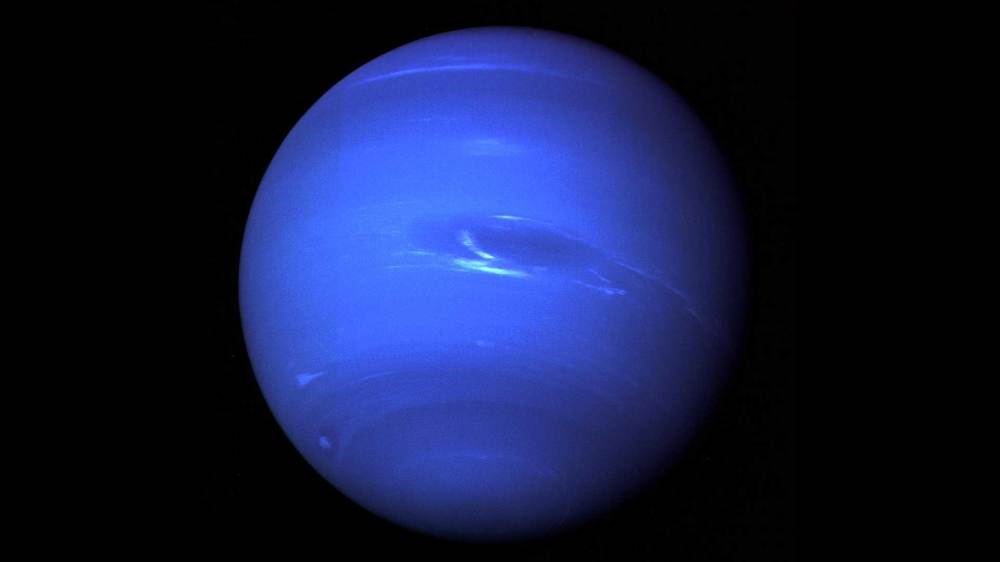
Neptune is roughly 30 times farther from the Sun than Earth. Its atmosphere consists mainly of hydrogen, helium and methane. Image processing also affects its appearance: the vivid blue of familiar pictures does not precisely represent the view a human eye would see.
Neptune's discovery demonstrated the power of mathematical prediction. Irregularities in Uranus's motion helped researchers calculate where to look for another planet. In 1846, observers found it in the predicted region of the sky.
How we explore it
Voyager 2 explored Neptune during its 1989 flyby, revealing its atmosphere and the moon Triton.
Sources & measurements
NASA: planet facts NASA/JPL: physical parameters NASA/JPL: orbitsDiameter is the mean volumetric diameter, rounded to the nearest kilometre. Periods use Earth days or years. AU values are rounded orbital semi-major axes; instantaneous distances differ.