TOOLS OF DISCOVERY · 2 MIN READ

How can geometry measure a star’s distance?

Earth’s journey around the Sun gives astronomers different viewpoints for measuring nearby stars.
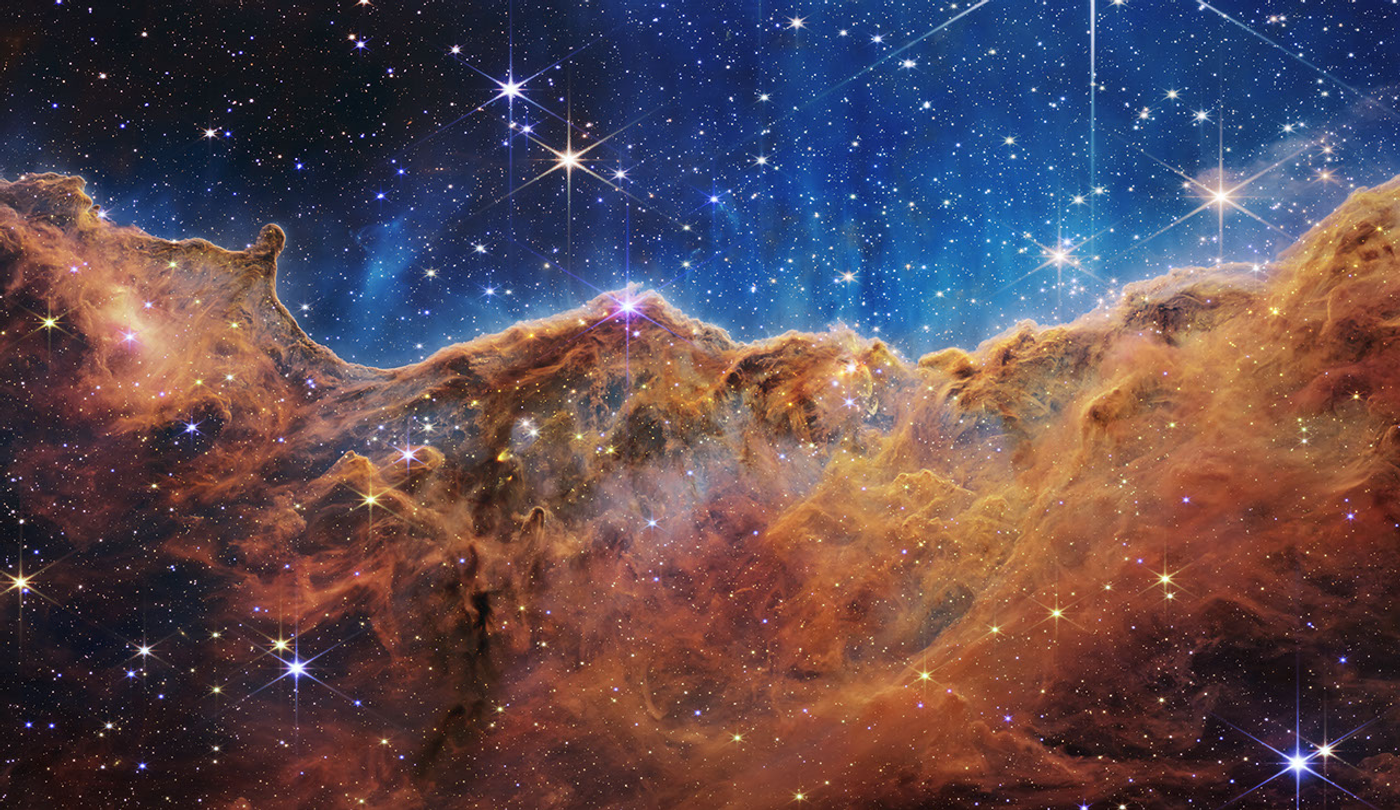
The Cosmic Cliffs in the Carina star-forming region. A Webb infrared composite with colours assigned to filters.
The Cosmic Cliffs in the Carina star-forming region. A Webb infrared composite with colours assigned to filters. NASA / ESA / CSA / STScI

A shifting viewpoint

Hold out a finger and alternate between your eyes. It seems to shift against a distant background. A nearby star similarly appears to move as Earth changes position during its orbit.

Define the angle

The parallax angle, p, is half the maximum annual side-to-side displacement. It corresponds to a baseline of 1 AU. Astronomers separate this repeating shift from the star’s own motion through space.

Turn angle into distance

With p in arcseconds, distance in parsecs is approximately 1 ÷ p. One parsec is about 3.26 light-years. Smaller parallaxes indicate greater distances, while measurement uncertainty limits precision.

TRY THE IDEA

Calculate a distance

An idealised star has a 0.20-arcsecond full annual shift. How far away is it?

Explore the answer +

p = 0.10 arcseconds, so d = 1 ÷ 0.10 = 10 parsecs, or about 33 light-years.

✦

Parallax turns a measured angle and a known baseline into a stellar distance.
Continue with the original source

NASA: explore this topic
← Back to the journal

ONE MORE QUESTION

There is always more to discover.

Stephan’s Quintet, an apparent group of galaxies. One of the five is closer than the others. A NIRCam and MIRI infrared composite.The scale of the universe

Why is a light-year a distance?

When kilometres become unwieldy, the journey of light gives us a more useful measure.

The Cosmic Cliffs in the Carina star-forming region. A Webb infrared composite with colours assigned to filters.The lives of stars

Why do stars shine?

Behind a star's steady glow lies a balance between gravity and pressure in hot matter.

Schematic illustration: black hole and accretion discAstrophysics

What lies beyond the event horizon?

A black hole has a boundary beyond which even light cannot return to the outside universe.

Find your question

Popular in the atlas

Close with Esc

A little discovery

Did you know?

Explore the planet