INSIDE THIS WORLD
More than a point in the sky.
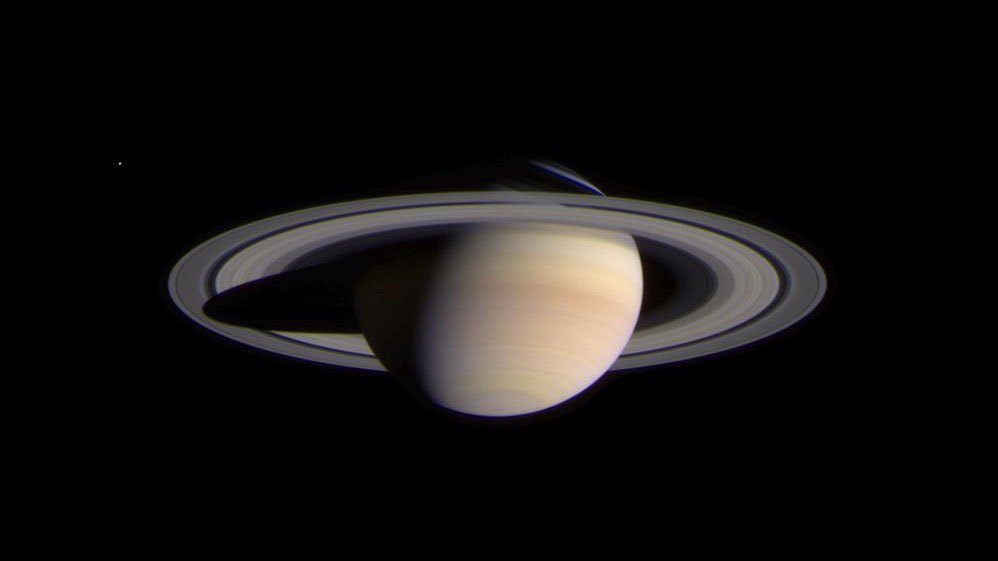
Saturn is a gas giant made mainly of hydrogen and helium. Its rings are not solid discs: they contain countless separate particles of ice and rock, each following its own orbit.
Gaps and intricate structures appear throughout the rings, shaped in part by the gravity of moons. Saturn's atmosphere also has strong winds, cloud bands and large vortices.
How we explore it
Cassini spent more than a decade studying Saturn, its rings and its moons, returning a wealth of detailed images.
Sources & measurements
NASA: planet facts NASA/JPL: physical parameters NASA/JPL: orbitsDiameter is the mean volumetric diameter, rounded to the nearest kilometre. Periods use Earth days or years. AU values are rounded orbital semi-major axes; instantaneous distances differ.